Fractions are hard. There are few kids (or even teachers!) who would say they love fractions. I recently found an excellent book that presents strategies to help teachers develop fraction sense in their students!
 Fractions have become a big focus in our project schools. With whole numbers, we show students three different ways, plus the traditional for solving whole number problems. But when we look a little deeper at fractions and decimals, we realize that there’s a lot more pedagogical work required of teachers to help students fully grasp these concepts.
But first, a story to illustrate why this book is so important!
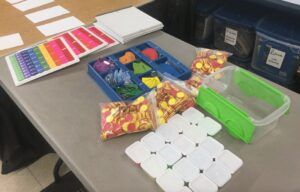
I was observing a 5th grade class one day while doing some reverse coaching with a principal. The lesson was on story problems with fractions, and the teacher had a variety of manipulatives available for the students to use. In our project schools, the teachers know that I am always looking to see what CPA (concrete, pictorial, abstract means) is being used within instruction, and this teacher had been working really hard to incorporate the manipulatives because it just wasn’t something that she had even been taught how to do until this point. The teacher had laid out clear counters, fraction tiles, 2-sided counters, patty paper, centimeter cubes, and pie piece fraction kits.
This lesson was towards the end of their addition unit with fractions, and I was observing the students to gauge their depth of understanding on this concept and see if they could go beyond just understanding the process and procedures of adding fractions to real-life application and explanation. The teacher had the class set up in a math lab format, with students working in pairs or groups of three. The groups were given 1-2 story problems to solve and then had to go to the manipulative table and basically prove their understanding. Here’s the problem that the students were given:
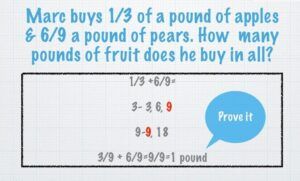 As the students began to work, I observed one particular group of students (one girl and two boys). The girl immediately dominated the group’s activity, grabbed dry erase boards, and started to add the fractions (⅓ and 6/9). She had her group members start by skip counting by 3s, then by 9s, and she identified that 9 was the common denominator. She came to the conclusion that if she added those fractions together, she’d get 9/9, which is equal to one whole.
I walked to the table and complimented her work, but told her I didn’t think her number was correct. She was quick to defend her position, and was able to explain what she did to arrive at that number. I said, “Ok, but I just want to make sure that you understand this because I’m not 100% sure that you’re right. Can you go to the manipulative table and get a concrete tool to prove your thinking? I’ll be back in a few minutes.” I was curious to see how group would handle this.
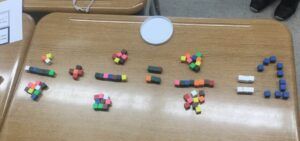
When I came back, the group was building on the desk with centimeter cubes. However, the group’s modeling consisted of the student writing the problem out in a creative design with the cubes! She was very confident in her thinking, but I had to tell her that she hadn’t really proved anything all. I asked her if she could pick another tool and prove the problem to me.
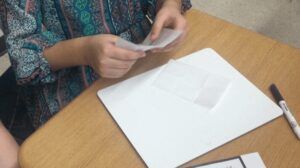 I had her use patty paper, which she folded into 3rds, and I folded another sheet into 9ths for her. I handed her the ⅓ of the piece of paper and asked her how she would put the sheets together if she were going to take the ⅓ add it to the 6/9. She wasn’t sure and said, “Well, I’m the one who does all the math. This is something the boys usually do!”
So we began a dialogue:
Shannon: You want to get a common denominator, right?
Student: Yes! and it’s 9ths!
Shannon: Why is it 9ths?
Student: Because it’s 6/9ths.
Shannon: Well, I don’t agree with you. What if I wanted to make it into 8ths, is that ok?
Student: *blank stare*
This student knew how to get the answer, but didn’t have a lot of understanding as to how she arrived at that answer or why.
When we’re looking at fractions, we tend to get kids into the procedural thought process before they’re ready, and as a result, students really don’t have a way to explain what they’re doing. We want to emphasize the 8 math practices with students, but when we are dealing with the understanding of fractions, we realize there typically isn’t a lot of content or substance to support what children know about them and they aren’t able to articulate the explanation of their actions very well.
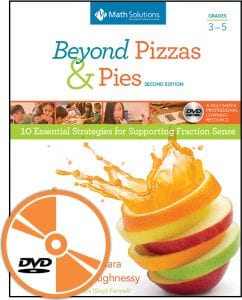 One of our math consultants and coaches, Kathleen Whitney told me about a great new books she read on the beach this summer: Beyond Pizzas and Pies by Julie MacNamara and Meghan M. Shaughnessy. This excellent book, published by Math Solutions and focused on grades 3-5, presents 10 essential strategies for supporting fraction sense. The best part of this book is the downloadable lessons that actually break down the different parts of fractions: proportional reason, problems with partitioning, understanding equivalencies, how to use fraction kits, is ½ always greater? The types of activities included with this book make it a profound resource for grades 3-5 to help teachers in an easy manner to break down how to go about teaching kids fractions in a conceptual way.