
About the Program
Return to Landing PageInterventions on the Go (IoG) is a flexible, skill-based math intervention system designed to help educators identify unfinished learning, provide targeted instruction, and monitor student progress. It can be used by classroom teachers, special education teachers, interventionists, paraprofessionals, and other support staff to provide support across Tier 1, Tier 2, and Tier 3.
The system combines diagnostic assessments, leveled intervention pathways, Pathway Instructional Guides, Independent Practice, progress monitoring, and teacher supports to help educators match instruction to students’ specific needs.
Each level includes 5–10 intervention pathways centered on Concrete, Pictorial, and Abstract (CPA) thinking. Students build conceptual understanding through hands-on models and visual representations before moving to abstract reasoning and procedures: discovering the “why” before memorizing the “how.”

What’s Included
Digital access to each intervention level includes:
- Diagnostic assessments
- Pathway Instructional Guides
- Independent Practice
- Progress monitoring assessments and recording sheets
- Downloadable templates and resources
- Instructional videos and teacher supports
Manipulative kits are available separately and support up to five students at a time. Schools with existing SIS math tools and manipulatives may use those materials instead.
Who Is IoG For?
IoG supports students who are:
- Slightly below grade level
- One or more years below grade level
- Missing foundational concepts
- In need of additional grade-level reinforcement
How Interventions on the Go Works
The intervention process begins by identifying students who may need additional math support through universal screeners, district assessments, classroom data, and teacher observations. Once students are identified, teachers administer a diagnostic assessment aligned to the previous grade-level standards to determine specific areas of unfinished learning.
Based on assessment results, students are placed into targeted intervention pathways that address their individual skill gaps. Teachers then use intervention Pathway Instructional Guides, math tools, Independent Practice, and teacher supports to provide focused instruction.
Intervention should not simply repeat classroom instruction. Effective intervention identifies and addresses specific gaps in understanding through targeted, observable, and measurable instruction provided consistently over time.
Progress monitoring assessments are used throughout the intervention process to help teachers determine student growth and readiness to move forward. Students should participate in at least 15 minutes of intervention consistently over multiple sessions before progress monitoring check-ins are administered. As students demonstrate understanding and mastery, they can move flexibly through the intervention pathways toward grade-level proficiency.

Understanding Levels & Pathways
Interventions on the Go is organized into overlapping instructional levels designed to support students performing below, approaching, or at grade-level expectations. Students are placed into pathways based on diagnostic data and demonstrated skill gaps rather than grade level alone.
Students may move between levels and pathways as they progress. The goal is targeted intervention that builds understanding, confidence, and long-term mathematical success.
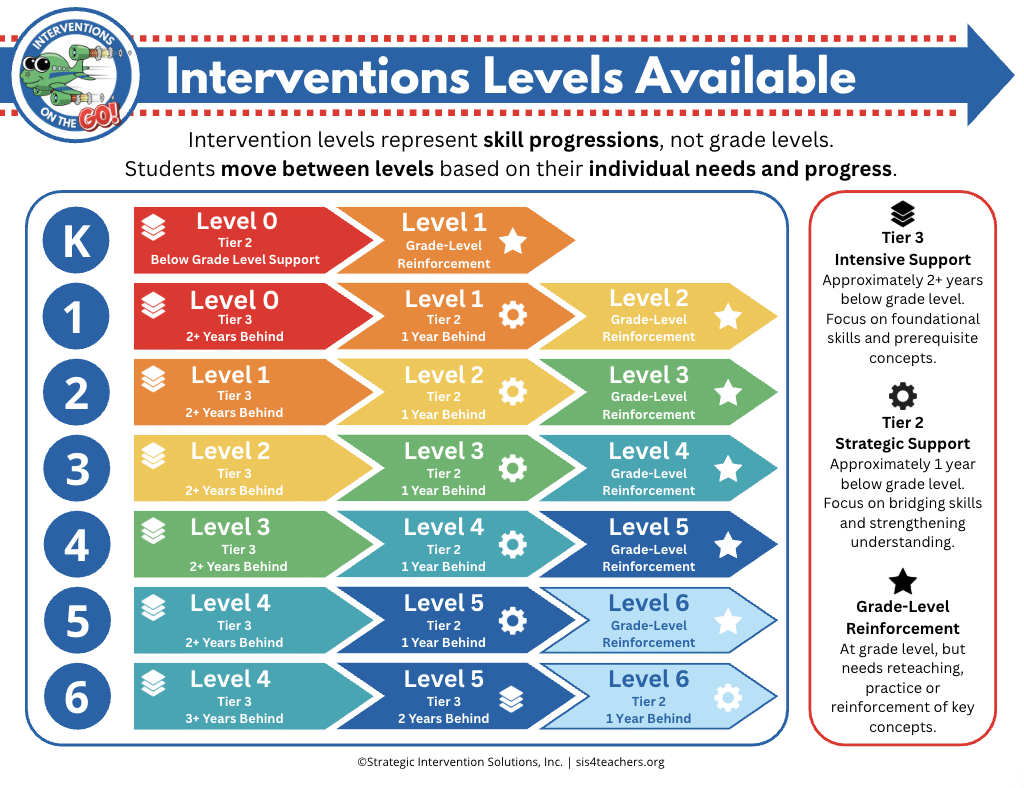

The Interventions on the Go levels are designed as a mathematical progression that builds from foundational numeracy concepts to advanced operations with fractions and decimals.
Each level focuses on major mathematical concepts and skill pathways that help students strengthen unfinished learning while building confidence and conceptual understanding through concrete, pictorial, and abstract instruction.
As students demonstrate mastery, they may move between pathways and levels based on their individual needs and progress monitoring data.
Each grade level has access to multiple intervention levels designed to support students with varying instructional needs. The grade-level snapshots below provide an overview of the levels, pathways, and mathematical concepts most commonly used within each grade band.
Students may enter different pathways based on diagnostic assessment data and demonstrated skill gaps. Intervention is intended to remain flexible, targeted, and responsive as students progress toward grade-level understanding.

6th Grade Intervention Pathway

5th Grade Intervention Pathway

4th Grade Intervention Pathway

3rd Grade Intervention Pathway

2nd Grade Intervention Pathway

1st Grade Intervention Pathway

Kindergarten Intervention Pathway
The Intervention Process
Before beginning intervention, it is helpful to understand the complete instructional cycle used throughout Interventions on the Go. Regardless of the student’s grade level or instructional level, every intervention follows the same sequence, from identifying unfinished learning through monitoring progress and determining next steps. This consistent process ensures that instruction is targeted, efficient, and driven by student data.
Before Intervention — Universal Screener (District owned):
Schools often use universal screening data (e.g., NWEA MAP Growth, i-Ready Diagnostic, Renaissance Star Math, or FastBridge) to identify students who may benefit from additional intervention. Many districts begin by reviewing students performing in approximately the lowest 20–25 percentile of the grade level, along with classroom performance, formative assessment data, and teacher observations, to determine which students should receive additional diagnostic assessment.
Step #1 — Administer IoG Diagnostic:
Begin with the IoG diagnostic aligned to the student’s current grade level. Each diagnostic assesses the prerequisite skills from the previous grade level to determine whether students have the mathematical foundation needed for success with current grade-level expectations.

Step #2 — Determine the appropriate instructional level and pathway
Review the student’s performance across the diagnostic to determine whether unfinished learning is broad or isolated to specific pathways.
- Broad unfinished learning across most or all pathways suggests the student may need assessment at a lower instructional level.
- Difficulty isolated to one or two pathways suggests the student is likely ready for targeted pathway intervention within the current instructional level.
Once the appropriate instructional level and pathway have been determined, complete the level-specific Diagnostic Decision Form (located on each level’s home page) to document the selected instructional level, pathway, and corresponding Progress Monitoring Assessment before beginning intervention.

Step #3 — Establish Baseline Data
Once the instructional level and pathway have been identified, administer the first form of the level-specific Progress Monitoring Assessment.
The purpose of the Progress Monitoring Assessment is to identify the student’s specific misconception or area of need within the selected pathway. Rather than reteaching an entire concept, teachers use the results to determine exactly where instruction should begin.
The Progress Monitoring Assessment guides the selection of intervention activities and establishes a baseline for measuring student growth throughout the intervention process.
Record the student’s baseline results before beginning intervention instruction.

Step #4 — Prepare for Instruction
Organize each pathway into its own folder or storage bin that includes the Pathway Instructional Guides, manipulatives, printable resources, Independent Practice, and Progress Monitoring Assessments. Preparing materials in advance allows intervention sessions to begin immediately and maximizes instructional time.
Note: You do not need every material in the instructional kit for every lesson. Each Pathway Instructional Guide identifies the specific materials required for that activity. Organizing materials by pathway ensures students have exactly what they need for the targeted concept while making intervention sessions efficient and easy to manage.

Step #5 —Deliver Targeted Intervention
Use the results of the Progress Monitoring Assessment to select the appropriate intervention pathway and Pathway Instructional Guide. Provide instruction using the Concrete–Pictorial–Abstract (CPA) instructional sequence while allowing students multiple opportunities to build conceptual understanding before moving to abstract procedures.
Intervention should focus on the specific misconception identified through the Progress Monitoring Assessment rather than reteaching the entire mathematical concept.

Step #6 — Monitor Student Growth
Subsequent forms of the Progress Monitoring Assessments are administered after students have received consistent intervention and sufficient instructional opportunities. Use the corresponding Progress Monitoring Assessments to measure student growth and determine readiness to move to the next pathway.
Record each assessment using the Progress Monitoring Recording Sheet. The sheet automatically calculates student performance and provides color-coded indicators to help teachers quickly monitor progress over time.
Interpreting Student Progress


Mastery Decision
Mastery is defined as a score of 80% or higher. Students should consistently demonstrate mastery before progressing to the next intervention pathway. Professional judgment, classroom performance, and multiple Progress Monitoring Assessments should also be considered when making instructional decisions.
Materials
Manipulative kits are available separately and are designed to support up to five students at a time during intervention sessions.
These kits include both hands-on math tools and materials and printable resources aligned to the intervention pathways and CPA instructional model. The Pathway Instructional Guides outline the specific materials required for each pathway.
Additional resources and independent practice pages are also provided for each pathway and will need to be printed separately.
Schools that already have SIS math tools and manipulatives through previous SIS professional learning or resources may use existing materials in place of additional kits.


