If you thought Desmos was just for middle/high school students (like me!), you would be wrong! I recently developed a whole new appreciation and excitement for using this amazing tool in elementary school!
 I learned about Desmos from a colleague, Emily Kappel (@KappelEmily), an awesome math presenter I met at SDE Nationals in Vegas. She is a 4th grade teacher and absolutely bananas about Desmos. I finally made her sit down and show me what all the hype is about. I’ll be honest, I didn’t get it at first because a lot of the things I was seeing on Desmos were slope and graphing, plotting with algebra, but Emily was first person to show me how this related to the elementary sector!
To continue with our theme of math vocabulary, one of the classroom activities Desmos offers was designed with vocabulary in mind because “[…] words should result from a need to describe our world—this is where they gain their power.” While Desmos does have a lot of higher level math application games, Polygraphs are an activity that you could definitely bring down into the lower elementary grade levels (grades 2-6). The Polygraph game “foster[s] the pleasure and the power of words without the drudgery of the lists,” essentially providing an authentic area for students to practice their math vocabulary, along with their questioning strategies and higher order thinking skills. This perfectly aligns with the Math Practice 3, as we want students to be able to construct viable arguments and critique the reasoning of others, and Math Practice 6, as we want student to attend to precision in their language.
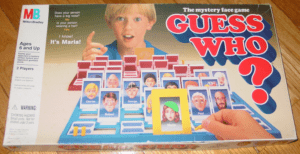 Do you remember the Guess Who game we used to play? Each player picked a character to flip down, and then the other person had to ask questions about the character’s features to see if they could guess who you had chosen. Does your character have glasses? If the answer is no, then I would eliminate all the characters that had glasses. We would keep exchanging questions until one person guessed the other person’s character. It might be fun helpful if students played Guess Who so they had a good grasp of the concept before you introduce the Polygraph game, which is essentially Guess Who for math!
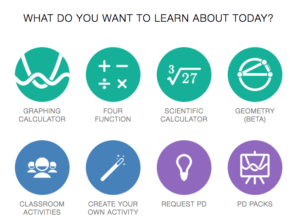
Do a quick search for “polygraph” in the search box and you’ll get over 50 pre-created games – everything from sinusoids to rational numbers to lines and parabolas. You can also find games that might work for younger students: 3D shapes, triangles, shaded rectangles. If you don’t see what you need, you can always create it! Use pictures and graphs to provide visual representation of your own concepts. This page gives a great snapshot of how the game is played and how both teachers and students interact with the game. https://teacher.desmos.com/polygraph-lines

Then, it works just like Guess Who. On your board are all the different ways you can express a fraction (on a number line, with a picture, parts of a set, etc.). The student has to pick one (for example, ½) and generate questions to ask the other student about their fraction (Is the number less than ½?). They ask these questions by typing them into a chat box.

On the teacher side of Desmos, it keeps a record of their questions for you to review later, which allows you to assess the student’s questioning strategies. Are they asking “thin” questions – more yes/no questions? Or are they asking “thicker” questions that require higher order thinking skills. You can even give feedback on their questions to encourage the types of questions you want from them. Teachers need an account to use Desmos. You can sign in with Google very easily, but even signing up with an email address is quick and easy.
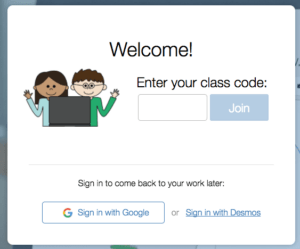
The student experience allows them to be matched up in a game to play with other students. Students can play the games without actually signing in, but it won’t save their progress if they don’t log in. They will need a code to access your activities. While the students are waiting, Desmos gives them questions or scenarios to think about, so there is no down time! I also really liked how the program gave the students the option to do a tutorial before starting the actual game, giving them tips and hints so they would be confident as they were playing.
Desmos also offers an Activity Builder with several different templates for application games. Check out their tutorials and start creating! http://learn.desmos.com/create