If you’re wondering whether to start with number talks or numeracy talks, you’re not alone. Teachers often ask:
“My students struggle with number sense—should I jump into number talks, or is there something I need to do first?”
The short answer: It depends on your learners’ readiness. If your students are still developing early counting skills, struggling with one-to-one correspondence, or can’t yet subitize small quantities, numeracy talks are the right place to begin. If they’re confidently recognizing numbers and ready for mental math, number talks will help push their thinking further.
In this article, you’ll learn:
-
- What numeracy talks are and how they build foundational number sense
- What number talks are and how they deepen math thinking
- The key differences between the two (with a helpful side-by-side chart)
- Real classroom insights and a teacher testimonial
- How to get started—including links to tools, screeners, and a full toolkit
By the end, you’ll feel confident knowing which talk to use, when, and why—and how to use them to transform your math block.
What Is a Numeracy Talk?
A Numeracy Talk is a classroom routine for PreK through early elementary students that builds the foundation for mathematical thinking. Unlike Number Talks, Numeracy Talks don’t use symbolic numbers or equations. Instead, they rely on visuals, concrete tools, and guided discussion to help children develop an understanding of quantity, patterns, and relationships—before formal operations begin.
Key Features of Numeracy Talks:
-
- Uses visual models like Deck o’ Dots, ten-frames, rekenreks, and counters
- Focuses on subitizing, one/two more or less, decomposing numbers
- Promotes verbal reasoning and math talk
- Scaffolds students from concrete to pictorial, preparing them for abstract thinking
- Differentiated with leveled decks (red, yellow, green) to meet students where they are
Why Numeracy Talks?
Too often, young learners are asked to memorize facts or solve equations before they understand what numbers mean. This leads to gaps in place value understanding, weak problem-solving skills, and struggles with mental math down the road.
Numeracy Talks solve this by giving students visual and conceptual entry points into math. With regular use, students build number sense, confidence, and the ability to visualize and discuss mathematical ideas—all before symbolic math is introduced.

“Numeracy Talks close the gap between counting and understanding — giving young learners the visual, verbal, and conceptual foundation they need to thrive in math.”
— Shannon McCartney, CEO & Founder, SIS4Teachers
What Is a Number Talk?
Once students are ready for symbolic math, number talks help develop flexible thinking, strategy use, and mental math fluency. These quick, focused routines present a problem or equation, and students solve it mentally, then discuss their strategies with the class.

Key Features of Number Talks:
-
- Used in grades 1–5, or with students who have basic number understanding
- Emphasizes strategy sharing (e.g., making tens, compensation, number line jumps)
- Builds mental math fluency and flexible thinking
- Teachers facilitate without correcting—students do the talking
- Encourages collaboration, confidence, and a growth mindset
Why Number Talks?
Math instruction has historically relied on rote procedures. Number Talks address this by focusing on the why behind strategies, not just the how. They create space for students to:
-
- Share their thinking
- See that math can be done in multiple ways
- Make mistakes in a safe environment
- Develop critical thinking and real-world problem-solving skills
A Teacher’s Perspective:
If another teacher was considering trying number talks for the first time, I would tell them to start small and trust the process. As a teacher, you do not need to have all the answers or even anticipate every strategy. Your students are doing all the thinking. You as the teacher are listening and recording the students’ ideas. From this, you can ask them questions to guide their thought process. You’ll learn so much about your students’ understanding just by listening and asking inquiry based questions. Your students will amaze you with their mental math strategies and you will see how empowered they feel when they realize there is more than one way to solve a problem.
So, what’s the difference?
Numeracy Talks
- PreK-1st grade students developing number sense
- Use visuals (Deck o’ Dots, ten-frames, counters)
- Focus on subitizing, quantity, more/less, decomposing
- Students build or model quantities
- Emphasize visualization and verbal reasoning
- Scaffolded wiht leveled decks (red, yellow, green)
- No written symbols or formal equations
- Prepares students for Number Talks
Number Talks
- Grades 1-5 or students with basic number understanding
- Use numbers and equations
- Focus on mental math strategies
- Students solve mentally and share strategies aloud
- Emphasize flexibility and strategic thinking
- Supported by Math Mights strategy characters
- Use symbolic math problems
- Deepens conceptual understanding
Ready to Get Started?
If you’re unsure where to begin, start by identifying your students’ current level of number understanding.
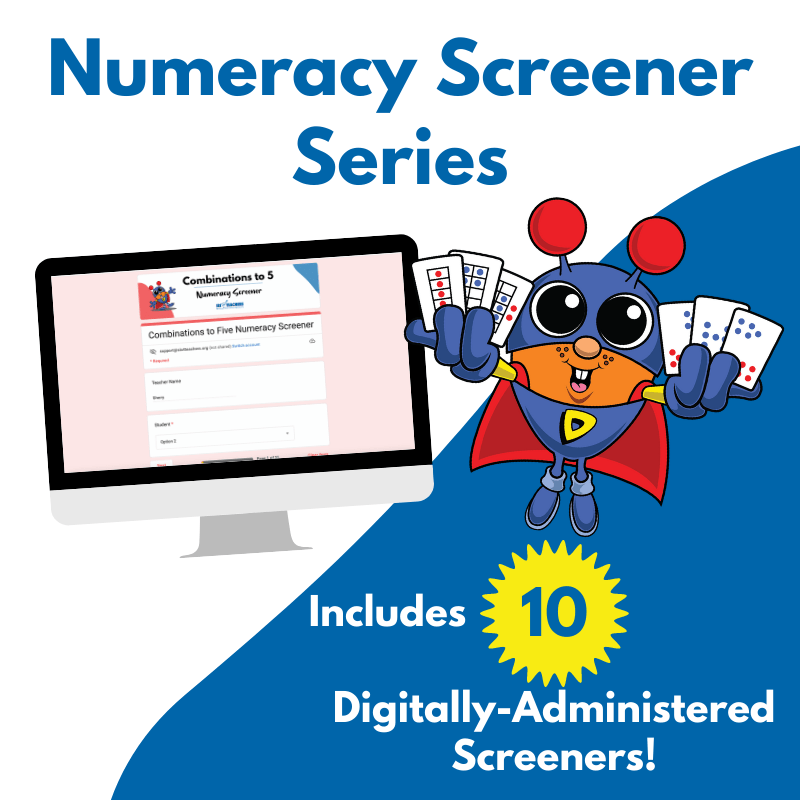
Try our Digital Numeracy Screener to find out where your students are with their numeracy progression!
Ready to implement with confidence? Our Numeracy Talks and Number Talks Toolkit is coming soon!—packed with everything you need: leveled decks, visual models, facilitator guides, and more. Be sure to join our SIS Insider List so you can be the first to know when the toolkit drops!
Final Thoughts
You don’t have to keep guessing whether your students truly understand numbers or have just memorized steps. Instead, empower your students to build number sense, think flexibly, and explain their reasoning in just 7-10 minutes a day, 3-5 times a week.