I love listening to kids and their math reasoning when you give them an opportunity to tell you how they think! They have masterful minds. I love the ways they come up with to tell you how their brain is thinking, and even if they aren’t sure how their brain is thinking, they tell you in their cute five-year-old way!
 I was recently in one of our project schools working with Kindergarten students on the Understanding Number Quantities screener. One particular student had aced conservation to 5, meaning that he had worked through all of the five frames and understood the number quantities represented even when I rotated them to show a different orientation of five. His knowledge of ten frames was exquisite, and I heard him say things like, “I know that it’s six because there are four empty,” or “I know that it’s eight because it’s five and three.” This student had lots of different reasonings to share and I could tell that he had a good grasp on part/whole understanding just by listening to him working the screener. Dice patterns were easy for him (he said he played lots of games at home and I could definitely tell!), and when I showed him the scatters, I was blown away that he knew every single one. When he saw three, three and three, he said “I know that it’s nine because I know three plus three is six, and three more is nine.” When I showed him one that was looked like the dominoes pattern of three, three and three, with two taken away, he knew it was seven because he said he saw six and one more.
 Typically our Understanding Combinations and Missing Parts screener is meant to be passed by the end of the first grade year, and we don’t administer it during the Kindergarten year. We typically don’t find Kindergarteners at this level unless they’ve had a lot of work to understand conservation, such as counting lots of things and engaging in lots of activities to help them develop the skill.
However, since this student seemed to be understanding number quantities really well and was already breaking apart numbers, I wanted to see if he could actually decompose numbers without seeing the full numbers. Could he see a digit (7), see the dice patterns of four and three, and tell me immediately that it was seven?
 This boy went through our Combinations and Missing Parts strips from the screener (pictured on the right). When I assessed him, he was able to tell me right away what the combinations were, getting about 74% of them correct. I was still curious, though, so I tried to move him on to see what would happen if I he tell me the part that was showing if I hid one of the parts? For example, if I had seven with four red dots and three blue dots, I covered the four and asked him, “If I wished that I had seven, but I only have this many [point to three dots], how many are under my hand?” He said, “Of course there’s three, because four and three equal seven.” Our super Kindergarten did have his limits, however, and finally fell apart when we got to some higher combinations of numbers like 7, 8, 9 and 10, which are more challenging numbers to decompose.
This screener was designed as a follow up for our Understanding Number Quantity Screener to see if students really understand combinations, and the idea for it emerged during my daughter Emma’s 1st grade year (she’s now in 6th grade). At an open house, I was talking to Mrs. Bertoia (the BEST first grade teacher of all times), and trying really hard to be the parent instead of an educator. I didn’t want to spend the evening talking shop, even though I knew Mrs. Bertoia had been to a few of my trainings.
At one point in the evening, she said was that they were going to start using XtraMath.org, a fluency-based website where a math fact will appear on the screen. You have 10 seconds to get it right, indicated by 10 circles at the bottom of the screen. The third one is a smiley face, if you don’t get it right within three seconds or it will disappear off the page because you aren’t fluent. As the parents were sitting around listening to this explanation, she asked me if I thought it was a good idea that we start this program. I wondered to myself if the students were ready for fluency because I didn’t think they really understood combinations. Although fluency to 10 is a standard for first grade, it is to be mastered at the end of the year. Most 1st grade students haven’t developed enough numeracy to have the number sense needed for some of the math concepts, and they don’t need drill and kill practice to start their year.
I was a good parent, though, and did my due diligence to take Emma to the website. At the time, she had a lot of factors working against her (she didn’t know how to use a mouse, she only had a half-day kindergarten, so I know she didn’t have a full hour of math in her class because it was more station-based and I felt like she was lacking in numeracy). I put her on Xtramath.org and the facts started flying. Emma was frantically looking at the keyboard and I was trying to help her find the number so she could enter it once she computed it. At the end of it, she was in tears because she only got smiley faces on a few of the facts families, and she left the experience thinking that she stunk at math.
I went to Mrs. Bertoia and asked how many kids in the classroom actually understood their combinations. It was soon after my screener was published, so I took a day off and went to screen the class on understanding combinations. I held the digit and showed the child the red and blue dots on the card (the four and the three) and I wanted to see (without counting!) if they could tell me the answer was seven. The class average as 34%. Only two students were ready for the missing addend part of the screener, and though they scored well, their reasoning wasn’t very strong. Looking back, these kids probably needed the Understanding Number Quantities screener, which is where we start most of our project schools when they start their first year with us.
Always an educator, I asked Mrs. Bertoia if we could start working with the students to understand combinations, eliminating “mad minutes” and timed test concepts until March or April and focusing on our foundation. We had used something like Deck o Dots (which wasn’t published yet at the time), to help them use it in their everyday math program to help them develop the numeracy they needed to be able to get it.
When we do a post-test with this screener, the students’ scores rapidly increase because they actually understanding combinations and missing parts. We don’t want to push kids into doing fluency, or what I call “getting sweaty with math.” Math shouldn’t be sweaty! It’s supposed to be fun and exciting!
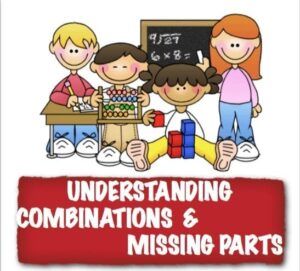 Once our students pass the Understanding Number Quantities Assessment, we assess all our first graders (and all of our second graders, if the school is in their first year with us) with the Understanding Combinations and Missing Parts screener. If anyone fails that, we take them back to the Number Quantities Screener to see where they need work. Instead of drilling and killing, we look for a pattern – are there certain facts that they do know and certain ones they don’t? If they do know the facts, are they able to see a part of it hidden and still understand the addend is there even though they don’t see it. (Ex. If the number is eight and I’m showing you five, the hidden number has to be three.) This give us a good idea of kids’ number sense and if they have a good foundation for what we’re looking for. Once kids have mastered this screener, we feel they’re ready to move into number bond cards addition and subtraction. This is in a digit format, so the child might see 8 and a four on one side of the number bond and have to figure out what goes on the other side. Or they might see a 4 and a 4 at the bottom of the number bone and then have to work out the total that goes at the top.
Once students get this idea of combinations and missing parts, and they can start to work on bringing in fluency-type activities. you can do lots of practice with the number bond cards, and you can use a game like Best Two Out of Three, where kids can look at a number like 8, go through the sheet and find the two parts that make up 8, so they might circle the 6 and the 2 because they total 8. Kids can play and get practice with these types of games. You can do a lot of addition and subtraction or missing addend games with our Deck o Dots additional resources. You can play Deck o Dots difference, sandwich, duel double flip. (work for combinations)
 Once you get to this point with your students, you’re also ready to open Time’s Up on Timed Tests and look for the addition/subtraction strategies that Eliza Thomas that they’ve written to help kids build fluency.
We don’t want to start first grade drilling and killing kids with addition and subtraction. Faster isn’t smarter, as we’ve mentioned before on our blog and is backed by research from people like the National Council for Teachers of Mathematics (NCTM). We want kids to have a full understanding of combinations and missing parts before they add to their math later on in algebra, for example, where the missing addend piece is crucial to them understanding what X is.
With the data you receive as the results screener will give you data to help you group kids because everyone will approach it a little bit different – some kids will be working on combinations, some might be on number bonds, some will be on the missing parts, or any of the other strategies in the Time’s Up on Timed Testing book.
This screener is available as a digital download or physical toolkit from our store!